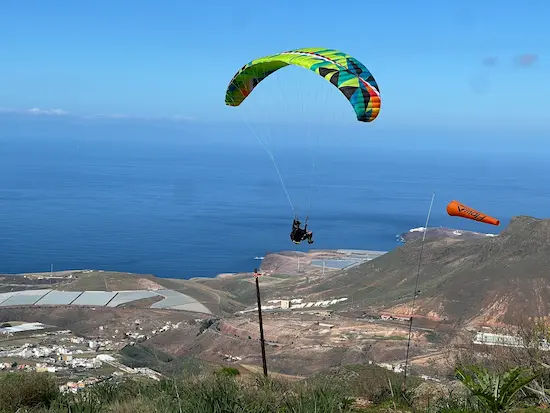
The Flying Islands is an audiovisual project about paragliding, wind and weather in the Canary Islands. Narrated by Bruce Goldsmith, it brings together flight footage, technical explanations and island landscapes to help free-flight pilots and paragliding enthusiasts better understand how the air behaves.
This post is not a booking page, but an authority piece within the paragliding content of Aventura en Canarias. If you are looking for a general overview of the ways to fly, learn or visit the island as a pilot, you can start with our main page about paragliding in Gran Canaria.
A journey through the Canary Islands to understand the wind
In The Flying Islands, a group of international paragliding pilots travels around several islands of the archipelago to observe, analyse and better understand local flying conditions. The aim is not only to show spectacular flights, but to explain what happens in the air and why each island works in a different way.
The Canary Islands are a very interesting setting for talking about weather applied to free flight. Terrain, wind, breezes, convergences, slope orientation and differences between islands create highly varied situations that help explain useful concepts for any pilot.
Paragliding in the Canary Islands: more than beautiful scenery
From the outside, paragliding may look simply like a spectacular way to enjoy the landscape. But for a pilot, every flight is a constant reading of the air: wind direction, strength, stability, thermals, lift, sink and possible changes during the day.
That is why The Flying Islands is so valuable: it uses the visual beauty of the Canary Islands as a background, but the real subject is the understanding of flight. It is not only about watching pilots fly, but about learning why they can fly there, what conditions they look for and how they interpret the environment.
If you want to explore these topics further, you can also visit the content about weather applied to paragliding.
Gran Canaria on the free-flight map
Gran Canaria has a special place in paragliding in the Canary Islands because of its combination of coastline, volcanic terrain, elevated areas and variety of orientations. It is not an island with a single take-off site or one fixed way to fly: each day requires assessing the weather and choosing the right area.
For someone arriving as a passenger, this means that the experience will depend on the real conditions of the day. For someone who is already a pilot, it means that understanding the island requires more than looking at a map: it requires knowing how wind, terrain and different take-off sites interact.
Convergences, breezes and reading the sky
One of the most interesting topics in The Flying Islands is the explanation of weather phenomena such as convergences. These happen when air masses with different characteristics meet and can create areas of lift that are useful for flying.
The project uses real footage and animations to show how these situations form and why they can be so important for paragliding pilots, hang glider pilots and other free-flight disciplines. For a pilot, understanding these processes can make the difference between a short flight and a much more complete experience.
Useful content for pilots and future pilots
The Flying Islands can be interesting for experienced pilots, but also for people who are beginning to feel curious about paragliding. It helps explain that flying is not only about taking off, but about interpreting the environment and making decisions with judgement.
If you have never flown before, your first step may be a flight accompanied by a pilot. If you want to learn, the right path will be a course. And if you already fly independently, the important thing will be to understand the areas, local conditions and safety criteria before choosing where to take off.
On our main page about paragliding options in Gran Canaria, you can see the different ways to approach this activity: tandem flights, courses and guidance for pilots.
The Canary Islands as a natural laboratory for flight
The Canary Islands offer exceptional variety for observing how flying changes depending on the island, the terrain, the orientation and the weather. Lanzarote, Tenerife, Fuerteventura and Gran Canaria can offer very different conditions, even during the same period of the year.
That is why many pilots see the Canary Islands as a place of continuous learning. It is not enough to know how to take off and land: you also need to learn to read the sky, understand the wind and respect the limits of each area.
If you want to learn more about flying areas, you can check this external resource about places to fly in Gran Canaria.
A project created from local experience
The Flying Islands was developed by Aventura en Canarias together with Fly in Canarias, combining local experience, flight knowledge and an audiovisual approach designed to show the islands from the air.
You can also find more technical and weather-related content at Fly in Canarias, especially if you are interested in the more analytical side of free flight.
Discover paragliding in Gran Canaria
If this type of content has made you curious about paragliding, Gran Canaria offers several ways to approach flying: trying an accompanied experience, starting a course or visiting the island as a pilot to discover its flying areas.
To see everything clearly organised, visit our main page about paragliding in Gran Canaria.
You can also follow the project on the The Flying Islands YouTube channel.