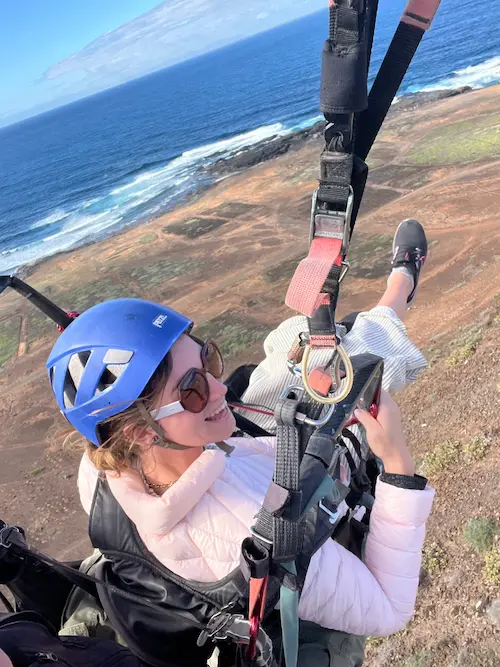
For many people, flying a paraglider in Gran Canaria is their first real flight experience. Before take-off, there are usually nerves, questions and curiosity; afterwards, what remains is often a mix of surprise, calm and the desire to see the island from above again.
This post is about that first flight experience: what it feels like, what role the wind plays, why the weather matters and how flying can change the way you see the landscape. If you want to see all the ways to approach paragliding on the island, you can start with our main page about paragliding in Gran Canaria.
The first time you fly a paraglider
Most people who try paragliding for the first time have no previous experience. That makes the moment before take-off special: there is expectation, respect for the unknown and a strong desire to discover what it will feel like to be in the air.
Once the flight begins, the feeling usually changes. What seemed like a very intense activity becomes, for many people, a smoother and more progressive experience than expected. The landscape, the relative silence and the sensation of gliding through the air become the centre of attention.
What you feel during the flight
Flying a paraglider does not usually feel like falling or like a rough attraction. The experience is more about gliding, floating and moving with the air. Take-off can create adrenaline, but once in flight many people describe a feeling of space, lightness and calm.
Depending on the conditions, the flight can be calmer or more dynamic. If the wind allows it, the pilot may use rising air currents near the terrain to gain some height and extend the experience. Even so, every flight always depends on the real weather conditions of the day.
Wind, terrain and free flight
Paragliding uses the wind, the terrain and rising air masses to stay in the air. In a way, it uses principles similar to those that allow many birds to glide and gain height without constantly flapping their wings.
In Gran Canaria, this relationship between wind and terrain is especially important. The island combines coastline, ravines, elevated areas and different orientations, so the flying area can change depending on the conditions. It is not only about choosing a beautiful landscape, but about finding the right moment and the right place.
Equipment and the importance of weight
Paragliding equipment is designed to work within specific weight ranges. In a flight accompanied by a pilot, the total weight of the passenger, pilot and equipment is taken into account. Flying within the right range helps the paraglider behave as it should.
That is why equipment, weather and the choice of flying area are all part of the preparation before the flight. From the outside, the passenger’s experience may look simple, but behind every flight there are important technical decisions.
Gran Canaria from the air
One of the most memorable parts of flying a paraglider in Gran Canaria is the perspective. From the air, the relationship between sea, mountains, ravines and urban areas is understood in a different way. The island stops looking like a sequence of separate places and begins to feel like a connected landscape.
For some people, the strongest memory is the emotion of take-off. For others, the calm of the flight. And for many, it is the moment when they recognise from above places they had already seen from the ground.
Ways to experience paragliding in Gran Canaria
If this first experience makes you curious, there are different ways to approach paragliding. You can try a flight accompanied by a pilot, start training if you want to learn to fly, or, if you are already a pilot, find out about the island’s local flying areas and conditions.
To see these options clearly organised, visit our main page about paragliding in Gran Canaria with Aventura en Canarias.