
Are you thinking about taking a tandem paragliding flight and still have questions? That is completely normal. Many people flying for the first time want to know if they need experience, how long the flight lasts, what to wear, what happens if the weather changes or whether they can fly even if they are afraid of heights.
In this article, we answer the most common questions before trying tandem paragliding. If you already know you want to fly and are mainly looking for practical information about formats, prices and availability, you can check the main page to plan your tandem flight in Gran Canaria.
1. What is a tandem paragliding flight?
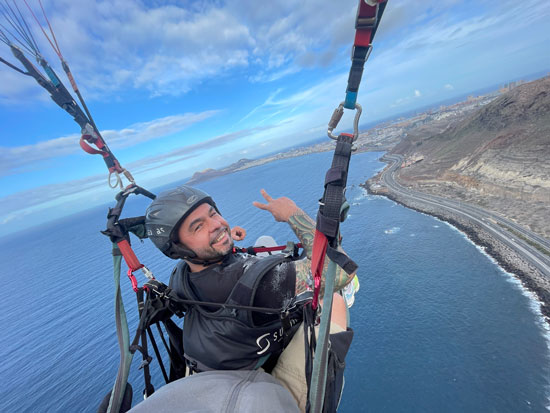
It is a paragliding flight where you are accompanied by a pilot. You fly as a passenger, while the pilot takes care of the technical side: preparing the equipment, controlling the paraglider, take-off, flight and landing.
That is why it is a simple way to discover free flight without taking a course or having any previous experience.
2. Do I need previous experience to fly?
No. Tandem paragliding is designed for people with no previous experience. Before take-off, you will receive a few basic instructions, mainly so you know how to move during take-off and landing.
3. Is paragliding safe?
Tandem paragliding is done with equipment designed for two people and with pilots trained for this type of flight. Before every activity, the weather conditions and the most suitable flying area are assessed.
Safety depends on several factors: equipment, pilot experience, weather, choice of take-off site and the passenger’s behaviour. That is why, if the conditions are not suitable, the responsible decision is to wait or change the plan.
4. How long does a tandem paragliding flight last?
The duration can vary depending on the wind, the flying area, the passenger’s weight and the type of experience booked. As a reference, many flights last around 12 to 15 minutes of actual flying time, although the full experience usually takes longer.
It is useful to distinguish between the time actually spent in the air and the total activity time, which may include organisation, transfers, preparation, waiting for suitable conditions and return.
5. What clothes and shoes should I wear?
It is best to wear comfortable clothes, closed shoes and a light jacket or windbreaker. Even if it feels warm on the ground, it can feel cooler in the air, especially if the flight gains some height or there is wind.
Avoid flip-flops, loose sandals or clothing that limits movement. Comfortable closed shoes are very helpful for take-off and landing.
6. Is there a minimum age to fly?
Children can fly in some cases, always with permission from their parents or legal guardians and only when their weight, the weather and the conditions of the day make it possible.
It is not only about age. It is also important to consider whether the child can follow simple instructions and whether the conditions are suitable for a comfortable and safe flight.
7. Can I fly if I am afraid of heights or have vertigo?
Many people who are nervous about heights can still enjoy a tandem flight. The feeling in paragliding is usually not the same as looking down from a balcony or a building, because there is no immediate vertical reference under your feet.
Even so, every person is different. If you are very afraid, it is best to mention it beforehand so the team can explain the process clearly and help you decide calmly.
8. What is the minimum and maximum weight for flying?
Weight affects the choice of equipment, the take-off and the conditions needed to fly. As a general reference, flights may be possible for children and adults of different weights, but the actual limits depend on the equipment available and the weather on the day.
If you weigh less than 40 kg or more than 100 kg, it is advisable to ask before booking so the best option can be assessed.
9. What happens if the weather does not allow flying?
If the weather conditions are not suitable, the flight may be postponed or reorganised. In paragliding, it is not safe to fly with any wind or at any time of day.
The final decision is made for safety reasons. Sometimes the day may look clear, but the wind direction, wind strength or air stability may not be appropriate for the activity.
10. Can you fly all year round in Gran Canaria?
Gran Canaria offers good flying possibilities during much of the year, but that does not mean you can fly every single day. The weather always comes first.
The island’s advantage is that it has different flying areas and orientations, which makes it possible to look for options depending on the conditions. Even so, every flight must be confirmed close to the planned date.
11. Do I have to run to take off?
Usually yes, although it is normally just a few steps. The pilot will tell you when to move forward and how to move. The most important thing is to follow the pilot’s instructions and not sit down too early.
If you have any physical limitation or doubts about take-off, it is best to mention it before the activity so the team can assess whether the flight is recommended and what conditions would be needed.
12. Where does the flight take place in Gran Canaria?
The flying area depends on the wind and the conditions of the day. In Gran Canaria, there are well-known take-off sites such as Los Giles, Las Coloradas, Agaete and other places that may work depending on wind direction and weather.
The final location is not chosen only for the views, but also for safety and flight quality. If you want to understand the usual flying areas better, you can also read our guide to paragliding take-off sites in Gran Canaria.
13. Can I fly with my partner, family or friends?
Yes, in many cases flights can be organised for several people. Each passenger flies with their own pilot, and if the conditions allow it, the flights can be arranged close together in time or even partly coincide in the air.
This depends on the number of pilots available, the conditions of the day and the organisation of the activity.
14. Can photos or videos be taken during the flight?
On many flights, it is possible to add photos or video so you can keep a memory of the experience. Action cameras are usually used and fixed securely.
If you would like photos or video, it is best to ask before the activity to confirm availability, format and conditions.
15. Can I bring my phone or camera?
It depends on how it is secured and on the pilot’s instructions. In the air, it is not advisable to carry loose objects, as they may fall or distract you during the flight.
For safety reasons, it is often better to use the pilot’s or team’s recording system, especially if you want to enjoy the flight without worrying about your phone.
16. What does it feel like to fly in a paraglider?
The feeling is usually a mix of excitement, calm and freedom. Take-off may make you nervous, but once in the air, many people are surprised by how smooth and quiet the flight can be.
It is not like a roller coaster. Paragliding is more gradual, more open and more connected to the landscape.
Do you want to clear up your doubts and plan the flight?
If, after reading these questions, you want to take the next step, check the updated information about formats, prices, availability and conditions on the main page to plan your tandem flight with a pilot in Gran Canaria.
Here is a video of a professional pilot flying tandem with several first-time passengers.